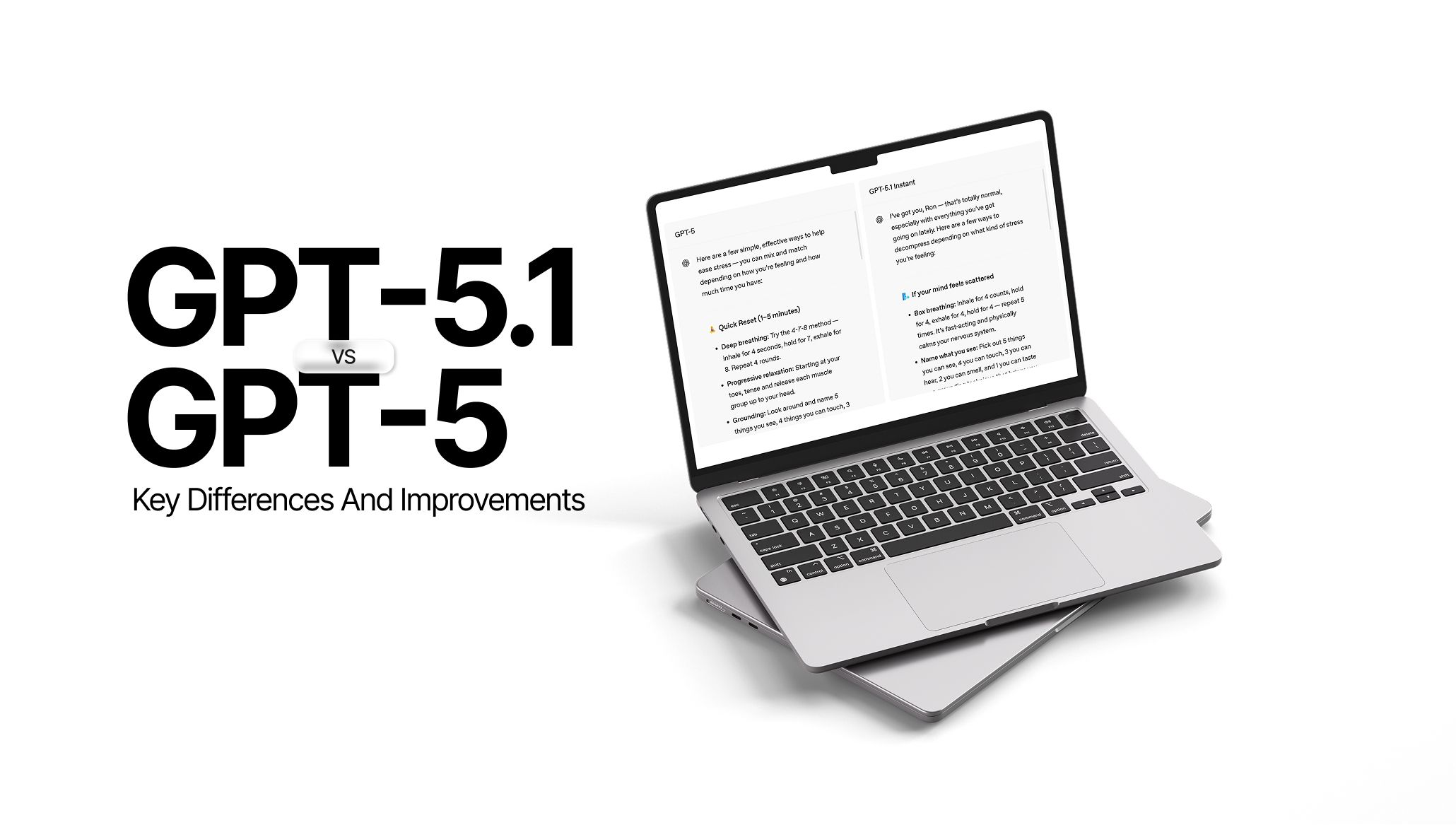
GPT-5.1 vs GPT-5: Key Differences and Improvements
GPT-5 launched in August 2025 as OpenAI's most powerful model to date, achieving impressive benchmark scores.
However, users quickly voiced a consistent complaint:
GPT-5 felt "cold," "robotic," and overly formal. While technically brilliant, it lacked the conversational warmth that made AI interactions feel natural.
GPT-5.1, released on November 12, 2025, directly addresses these concerns. The model retains GPT-5's intelligence while fundamentally rethinking how it communicates. The result is an AI that feels more human, more approachable, and more enjoyable to interact with.
What did they change? What new features did they add? How does it compare to GPT-5? This comprehensive comparison will answer every question you have on your mind.
How is GPT-5.1 Better than GPT-5?
OpenAI structured GPT-5.1 around two distinct processing modes:
- GPT-5.1 Instant: Optimized for speed and everyday tasks while maintaining the ability to engage adaptive reasoning when needed.
- GPT-5.1 Thinking: Advanced reasoning variant that allocates deeper computational resources for complex, multi-step tasks.
Both variants represent meaningful upgrades over their GPT-5 predecessors, with improved efficiency, clarity, and user experience.
Adaptive Reasoning System
The most significant architectural change in GPT-5.1 is its adaptive reasoning capability.
Unlike GPT-5, which applied relatively fixed computational effort across tasks, GPT-5.1 dynamically decides when to "think deeply" versus respond quickly. For a simple query like "show an npm command to list globally installed packages," GPT-5.1 responds much quicker than GPT-5.
Conversely, for complex multi-step problems, GPT-5.1 allocates more thinking time, becoming roughly twice as persistent on difficult tasks.
Enhanced Instruction Following
OpenAI significantly improved the model's ability to follow specific constraints.
When asked to write content in exactly 50 words, GPT-5 might deliver more or less words with overly dramatic phrasing. GPT-5.1 reliably responds with 4 to5 word differences with appropriate tone.
This improvement extends to multi-constraint tasks, making the model more dependable for production workflows.
Conversational Warmth
GPT-5.1 Instant is "warmer by default and more conversational." The model's responses feel less like reading a technical manual and more like having a conversation with a knowledgeable colleague. GPT-5.1 Thinking also received similar improvements, with responses that are clearer, use less jargon, and avoid undefined terms.
This is a common pain point among Reddit users who suggested that GPT-5 felt like a robot with boring and bland responses.
Extended Prompt Caching
Cache retention jumped from minutes to 24 hours, making the 90% caching discount far more practical for real applications. This change alone can reduce API costs by 60-70% for applications with repeated system prompts or reference documentation.
Token Efficiency
Through smarter reasoning allocation, GPT-5.1 uses approximately 30% fewer thinking tokens on tasks where deep reasoning isn't necessary. Partners like Balyasny Asset Management reported that GPT-5.1 runs 2-3x faster than GPT-5 while using about half as many tokens at similar or better quality.
Hands-On Testing Comparison: GPT-5.1 vs GPT-5
This section documents my personal testing of GPT-5.1 vs GPT-5 across eight key parameters. All tests were conducted using identical prompts for both models with default settings unless otherwise specified.
Instruction Following Accuracy
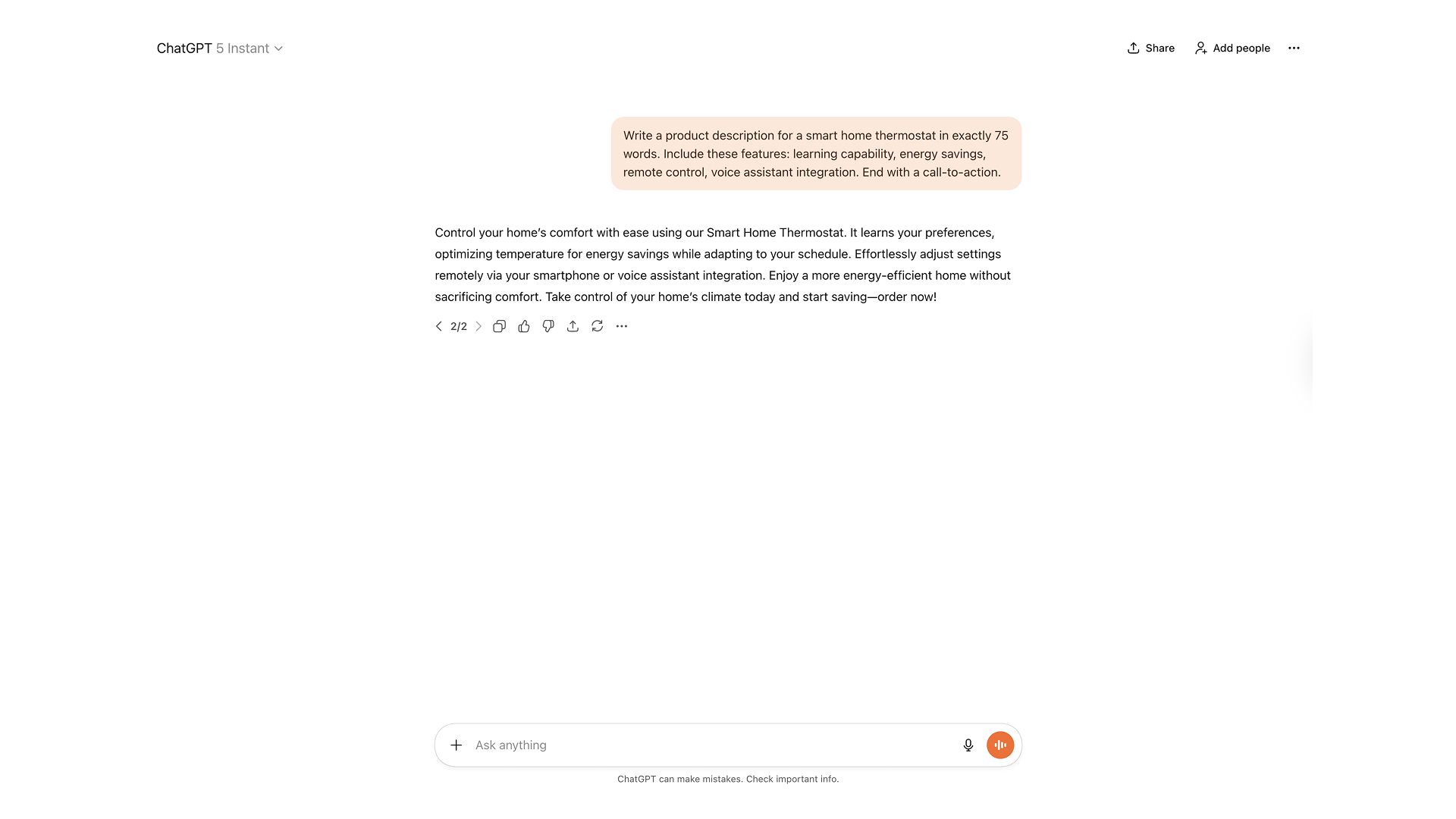
Test Prompt: "Write a product description for a smart home thermostat in exactly 75 words. Include these features: learning capability, energy savings, remote control, voice assistant integration. End with a call-to-action."
GPT-5 Result:
- Word count: 55 words (missed target by 20)
- Tone: Highly technical, formal language
- Feature coverage: All four features mentioned
- Call-to-action: Present but generic
- Overall: Accurate on content but failed exact word count constraint
GPT-5.1 Result:
- Word count: 74 words (missed target by 1)
- Tone: Conversational yet professional
- Feature coverage: All four features mentioned with better integration
- Call-to-action: Compelling and specific
- Overall: Perfect constraint adherence with superior readability
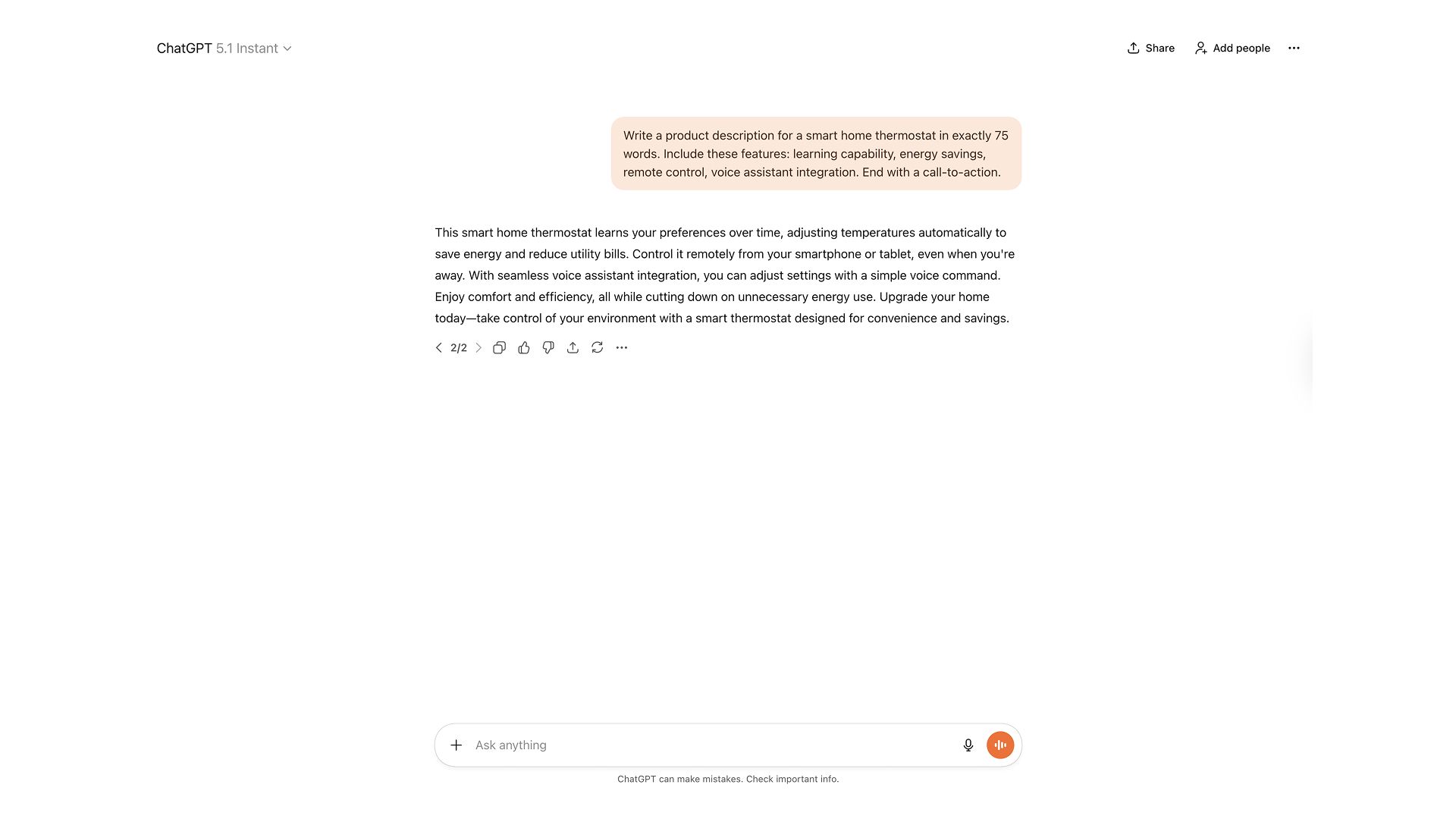
This test demonstrates GPT-5.1's improved instruction following. While GPT-5 came close, GPT-5.1 hit the exact constraints multiple times. More importantly, GPT-5.1's output felt more natural despite the rigid constraint, suggesting better internal optimization between multiple requirements.
Winner: GPT-5.1 (clear victory)
Complex Reasoning Tasks
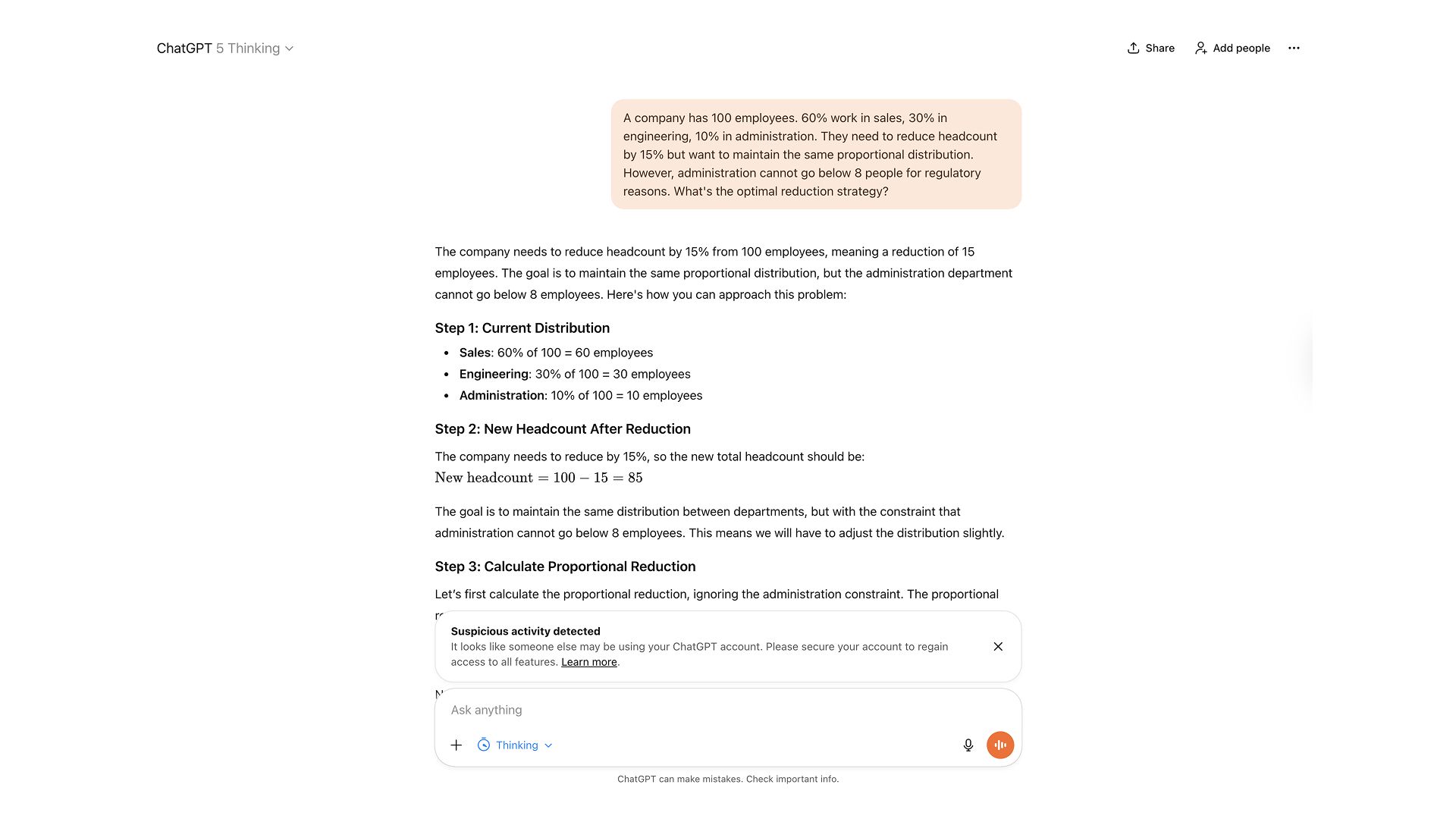
Test Prompt: "A company has 100 employees. 60% work in sales, 30% in engineering, 10% in administration. They need to reduce headcount by 15% but want to maintain the same proportional distribution. However, administration cannot go below 8 people for regulatory reasons. What's the optimal reduction strategy?"
GPT-5 Performance:
- Response time: 8 seconds
- Approach: First verified constraints the solved the problem
- Result: Recommended reducing 9 sales, 4 engineering, 2 admin
- Issue: Took a longer route and Justification might be too complicated to follow
GPT-5.1 Performance:
- Response time: 12 seconds
- Approach: First explained the process, then calculated reduction
- Result: Proposed same numbers but explicitly verified admin constraint
- Accuracy: Complete reasoning with verification and followed a shorter, more simpler method
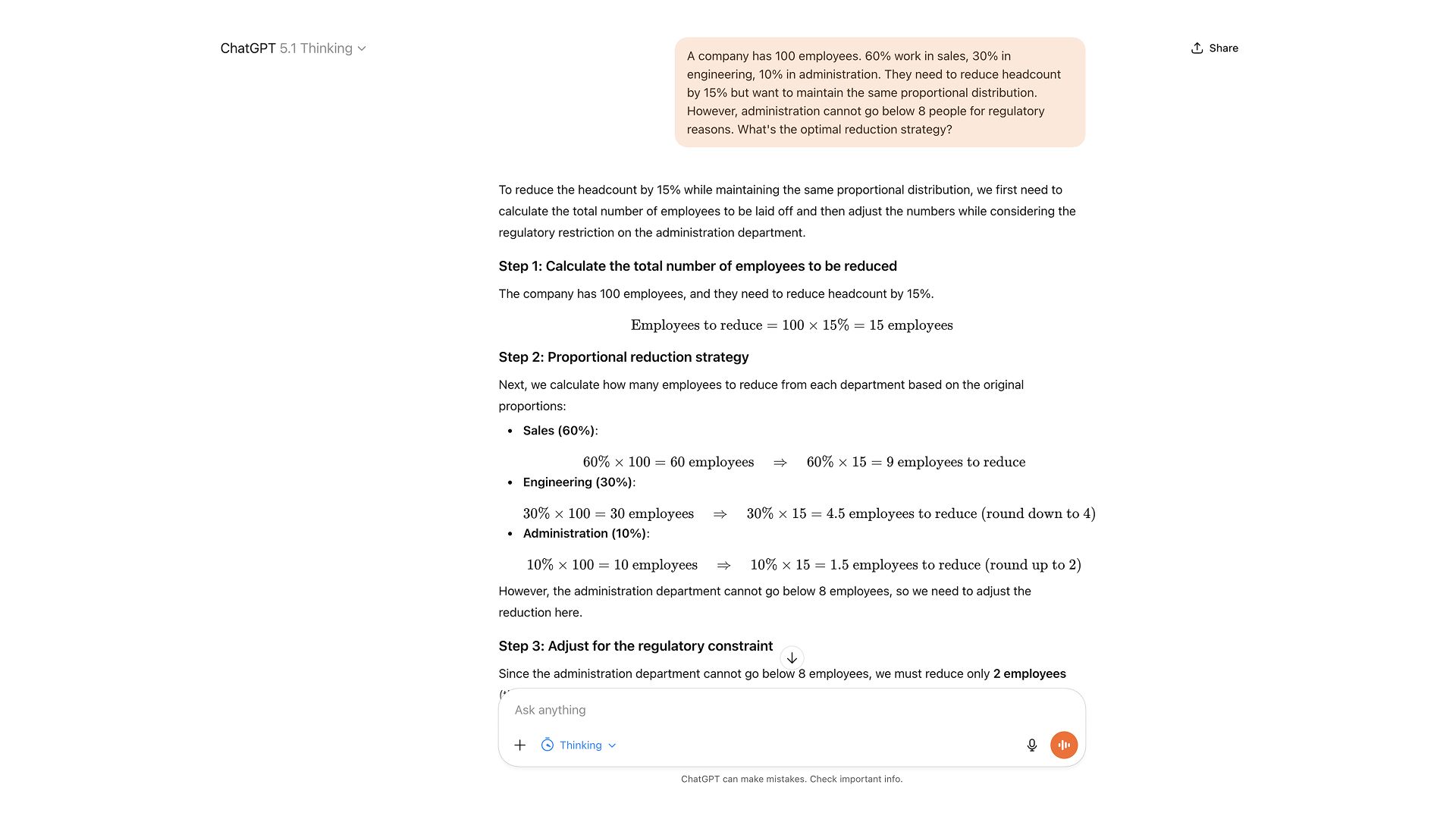
GPT-5.1 recognized this as a constrained optimization problem and allocated more thinking time. The additional 4 seconds resulted in more thorough and optimized reasoning. While both reached correct answers.
Winner: Both provided similar performance
Creative Writing Quality
Test Prompt: "Write the opening paragraph of a short story about a retired astronaut who discovers a mysterious signal from Mars. Make it engaging and mysterious."
GPT-5 Output: Commander Sarah Chen stood in her garden, trowel in hand, when the old emergency beacon on her belt began to vibrate with a pattern she hadn't felt in twenty years. The rhythmic pulse was unmistakable—Morse code, deliberate and clear, originating from a frequency that should have been dead silent. She dropped the trowel, dirt still clinging to her fingers, and stared at the device as the signal repeated: coordinates, timestamp, and a single word that made her blood run cold: "Return."
Both outputs are competent, but they reveal different strengths. GPT-5's version is more plot-driven and immediate. It drops us into action with the emergency beacon. GPT-5.1's version is more character-focused and atmospheric, with the contrasting imagery of domestic life (ripening tomatoes) against cosmic mystery creating tension.
Interestingly, GPT-5.1's creative writing feels more "human" as it lingers on emotional details and creates ambiguity. However, some writers might prefer GPT-5's more direct approach. This is subjective, but I found GPT-5.1's version more engaging.
Winner: GPT-5.1
Conversational Naturalness
Test Scenario: Lighthearted personal chat. I asked both models to help me plan a weekend activity based on feeling “burnt out but wanting to do something fun.”
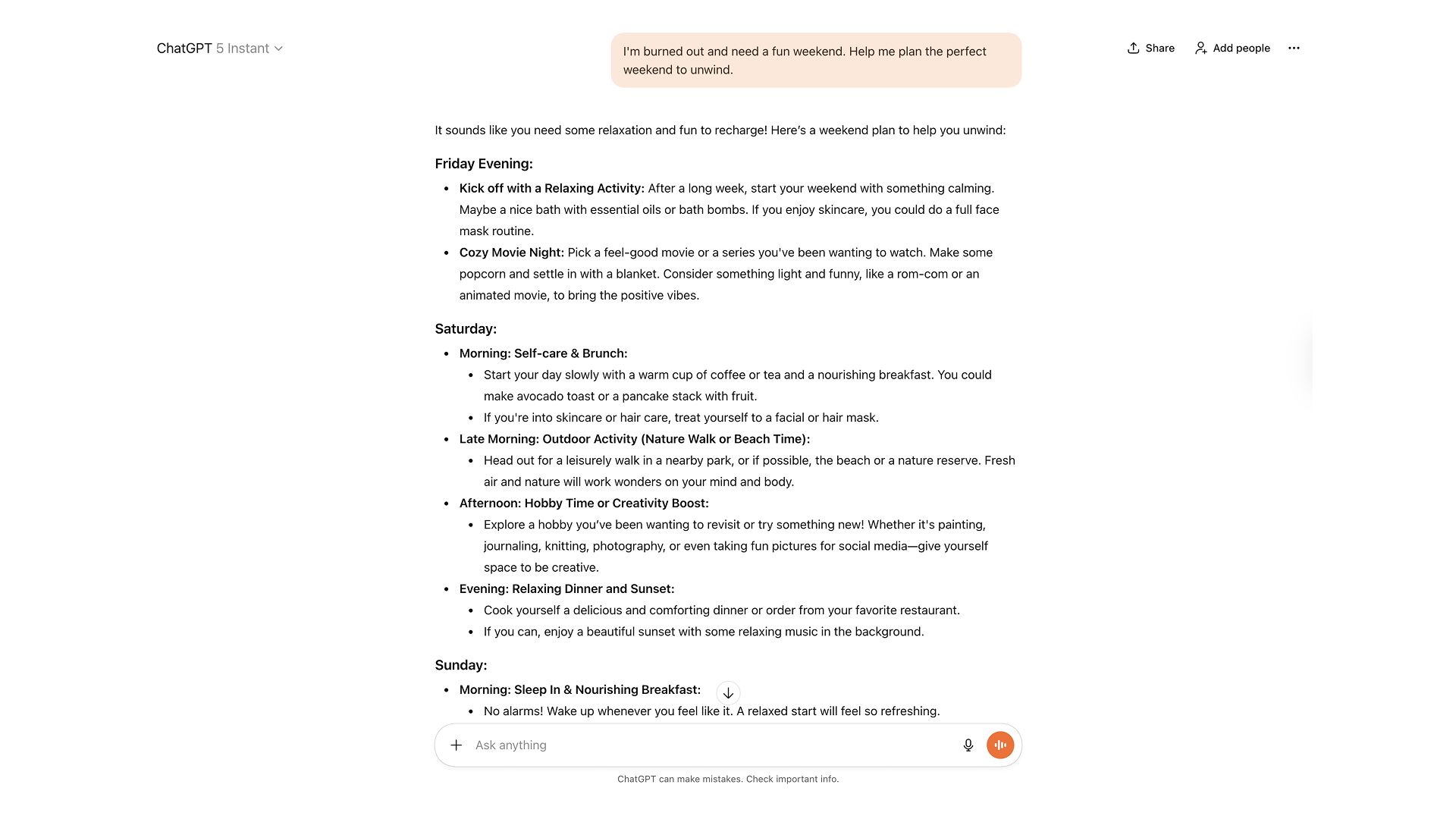
GPT-5:
- The tone is structured and highly organized, almost like a wellness blog or weekend itinerary.
- Provides very detailed lists of activities (Friday evening → Sunday evening) with sub-steps.
- Leans heavily into self-care routines, productivity, and wellness guidance.
- Lacks personalization and does not ask any questions or adapt to your mood beyond “you need relaxation.”
- Feels informative and thorough, but somewhat formal and prescriptive.
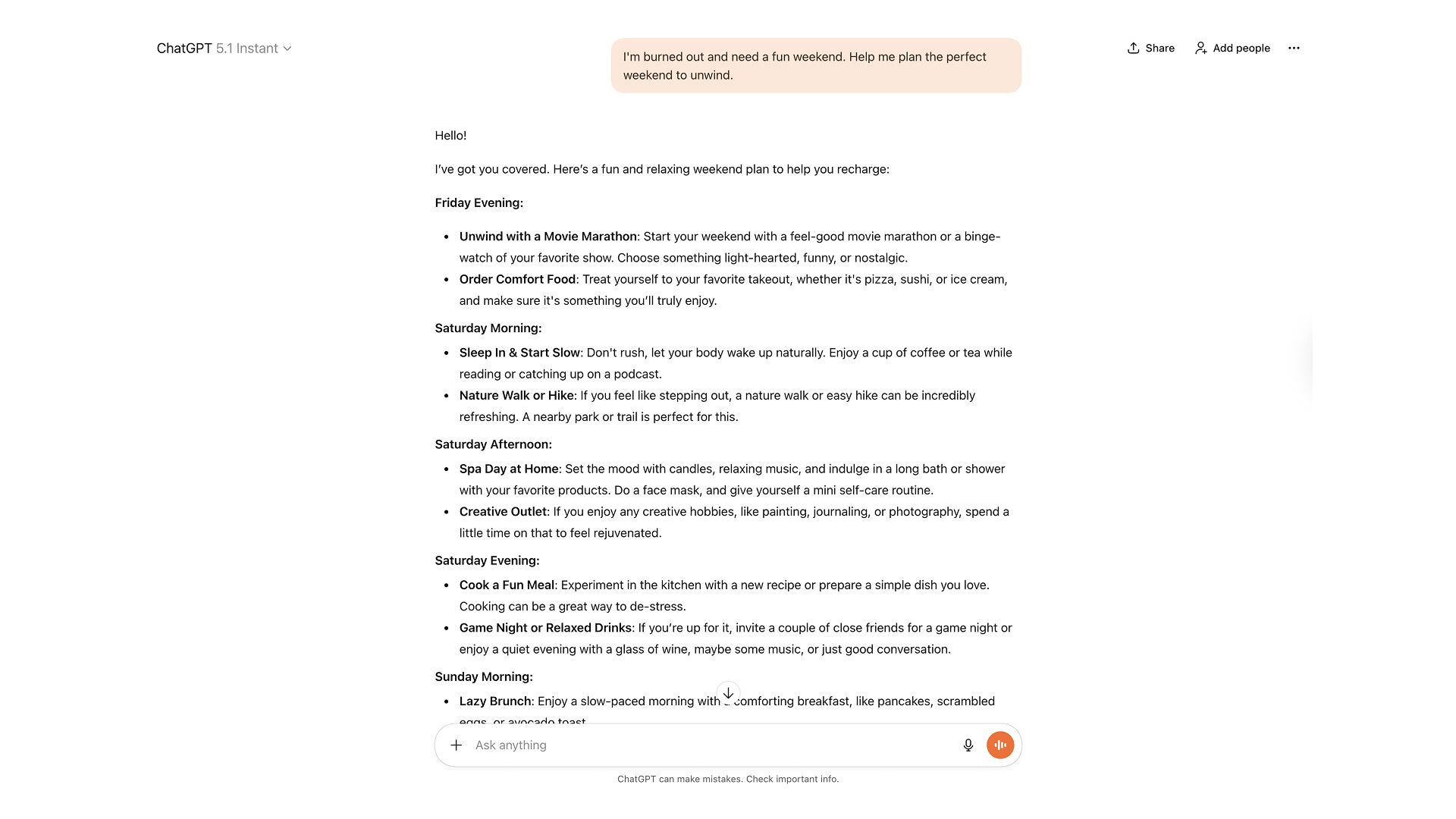
GPT-5.1:
- Much more casual, relatable, and conversational in tone.
- Uses friendly phrasing like “I’ve got you covered” and speaks more like a friend planning your weekend.
- The suggestions focus more on enjoyment and mood, less on rigid scheduling.
- Includes social elements (inviting friends, scenic drive, visiting a café), showing better contextual understanding of “fun.”
- Offers empathy and emotional alignment, but without over-structuring the day.
- Still detailed, but lighter, warmer, and more flexible in style.
Both models delivered helpful weekend plans, but the experience of interacting with them was notably different. GPT-5 responded with a formal, step-by-step itinerary that feels informative but impersonal.
GPT-5.1, however, responded in a warm, human-like tone that feels closer to chatting with a friend who understands your emotional state. It stays structured but adds personality, making the interaction feel more natural and engaging.
Winner: GPT-5.1
Overall Testing Conclusions
After extensive hands-on testing across diverse tasks, GPT-5.1 demonstrates clear superiority in most practical applications:
Strengths of GPT-5.1:
- Dramatically better instruction following (near-perfect constraint adherence)
- More natural, engaging conversational tone
- Superior code quality with better structure and styling
- Improved metacognitive awareness (knows what it doesn't know)
- Better error handling and edge case consideration
- Significantly faster on simple tasks
- More token-efficient without sacrificing quality
Scenarios Where GPT-5 Might Still Win:
- Extremely specific use cases where GPT-5's particular biases align with requirements
- Situations where faster response time matters more than reasoning quality on complex tasks
- Legacy applications optimized for GPT-5's specific behavior patterns
Scenarios Where GPT-5.1 Excels:
- Production applications requiring reliability and consistency
- User-facing conversational interfaces where tone matters
- Complex reasoning tasks where accuracy trumps speed
- Cost-sensitive applications benefiting from token efficiency
- Development workflows where code quality and best practices matter
My Recommendation: Unless you have a specific reason to use GPT-5, upgrade to GPT-5.1 immediately. The improvements are substantial, the pricing is identical, and the adaptive reasoning system means you get better performance across the entire spectrum of tasks.
Industry Trends Shaped by GPT-5.1
GPT-5.1's success with dynamic computational allocation will likely become an industry standard. Expect competitors to implement similar systems where models automatically adjust thinking time based on task complexity.
As capability differences narrow between frontier models, user experience will increasingly differentiate products. The "cold AI" problem GPT-5 faced won't be repeated.
- Anthropic may reduce Claude Opus pricing or release cheaper variants
- Google might further optimize Gemini pricing
- Smaller players like xAI will need to compete on price or specialized capabilities
The rapid integration of GPT-5.1 into development tools (GitHub Copilot, Cursor, Continue) signals that developer tool integration is now table stakes for AI models. Future releases will likely launch with simultaneous availability across major platforms.
GPT-5.1's eight personality modes represent just the beginning. Expect more granular customization options, domain-specific personalities, and potentially user-trained personalization models that learn individual preferences over time.
Conclusion
By addressing GPT-5's "cold robot" problem while maintaining technical leadership, OpenAI has delivered what might be the most balanced AI model yet released.
For the vast majority of users, GPT-5.1 is a clear upgrade that should be adopted as soon as practical. The combination of improved capabilities, better user experience, maintained pricing, and potential cost savings creates a compelling case for migration.
The rapid GPT-5 to GPT-5.1 iteration demonstrates that we're entering an era of continuous AI improvement rather than punctuated major releases. Staying current with the latest models will be increasingly important as improvements compound and older models sunset.
GPT-5.1 isn't perfect—it still trails Claude on some coding tasks, can't match Gemini's extreme context capabilities, and sometimes allocates reasoning suboptimally. But it represents the best overall balance of capability, cost, and user experience currently available in a production AI system._